May Day: What It Is and Why It Matters
May Day (or International Workers’ Day) – which falls on May 1st, 2026 – is quickly approaching and in this period where the state is consolidating its power to repress the workers movement, the relevance of May Day to workers is becoming even more clear. As economic conditions worsen to the point where the forty hour work week no longer provides a living wage, its relevance to workers increases by orders of magnitude.
Born From Struggle
May Day has a rich history born from the struggle for an 8 hour workday. In 1884, the Federation of Organized Trades and Labor Unions of the United States and Canada (which would later become the American Federation of Labor) resolved that the legal work day would be exactly 8 hours by May 1, 1886. The Federation did not specify exactly how this resolution would be achieved, but the implication was clear: this would be achieved through workers’ power. In other words, it would be achieved through strikes. Even before the 1884 declaration, the power of the workers to strike was showing its potency. In the 1870s railroad and steel workers engaged in strikes against the corporations that were taking advantage of them and the bosses who oppressed them. Their strikes were so effective that it took the federal government troops to break them.
The workers who made up the unions of the Federation prepared for years for the events that would transpire in 1886.. The number of strikes between the 1884 declaration to before May Day 1886 were immense and extremely potent. It was clear that workers believed in their cause and morale was at a high pitch – despite sabotage by the leadership of the reformist workers’ organization called the Knights of Labor.
Many different cities had their own strikes on May 1st, 1886 - like Washington, Baltimore, Milwaukee, New York, St, Louis, Pittsburgh, Cincinnati, Detroit, and others – but none were as large as the strike in Chicago, which was home to a very large militant movement. In addition to the Federation of Organized Trades and Labor Unions, organizations like the Central Labor Union and the Socialist Labor Party also took part.
The Haymarket Affair
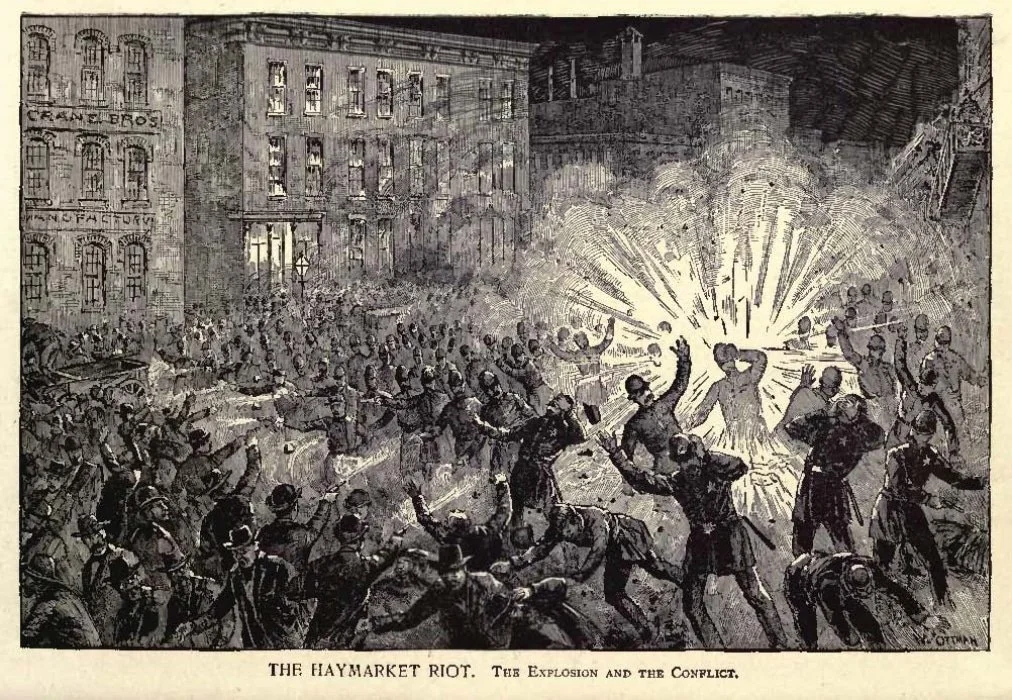
Chicago was the heart of the labor movement in the United States, and in order to both crush its movement and strike fear in the hearts of workers across the country, bourgeois business owners and the government collaborated to arrest or kill large numbers of the strikers. The protests continued to intensify on May 3rd and 4th of 1886, culminating in a bloody battle in Haymarket Square when police and private mercenaries (known as “Pinkertons”) attacked the workers. This would come to be known as the Haymarket Affair. After deaths on both the side of the workers and the police, several labor leaders – George Engel, Adolph Fischer, Albert Parsons, and August Spies - were falsely accused of throwing a bomb into the crowd and executed by way of hanging.
The Legacy of May Day
By 1889, the founders of the Socialist International (aka the Second International) gathered in Paris to honor the workers’ movement around the world but especially those who died in service to the 8 hour workday. Friedrich Engels, in the 1890 edition of the Communist Manifesto, wrote about May Day and honored all workers who died in service of the goals of the working class, lamenting that his dear friend Karl couldn’t see it with his own eyes alongside him.
The spirit and cause of May Day continued to spread around the world. While in prison in 1896, Vladimir Lenin memorialized it for one of the early Russian Marxist organizations. He would go on to write leaflets and articles for May Day even after the Russian Revolution had been successful. His successors in leading the Soviet Union would also use May Day as a celebration of the victory of socialism in their country.In countries like China, Vietnam, and the Democratic People’s Republic of Korea, May Day is a celebration of the victories of their revolutions.
In Africa, where the colonizers had taken so much, it is not just a day to celebrate the workers of Africa but also to celebrate the defeat of the colonizers. On May Day 1964, the great Pan-African revolutionary Kwame Nkrumah gave an incredibly important speech, acknowledging the victories of the African Revolution and giving credit to the victories of the world socialist system as an external factor contributing to the success of revolutionary forces in Africa. He acknowledged the workers of the Soviet Union, China, the newly freed socialist Cuba, Korea, and the rest of the socialist world for their help in the fight for liberation that the peoples of Africa were waging.
Other revolutionaries in Africa had used or attempted to use May Day to unite their countries on a class basis, emphasizing unity between workers, rather the divisions that the capitalist countries tried hard to keep alive.
In the United States the 2008 financial crisis lead to an increase in the popularity of socialist politics – whether Marxist, anarchist, or “democratic socialist”. This has in turn led to renewed interest in May Day. Since the 2016 campaigns of reformer Bernie Sanders and fascist Donald Trump, almost every organization in the US that is dedicated to left-wing politics of some kind has grown. As the economy worsens and as oppression of the marginalized in this country worsens, more and more calls for May Day strikes occur. In the MCP, we are building the forces that will make May Day strikes as effective as they were in the past.