Labor Law has Shackled the Working Class
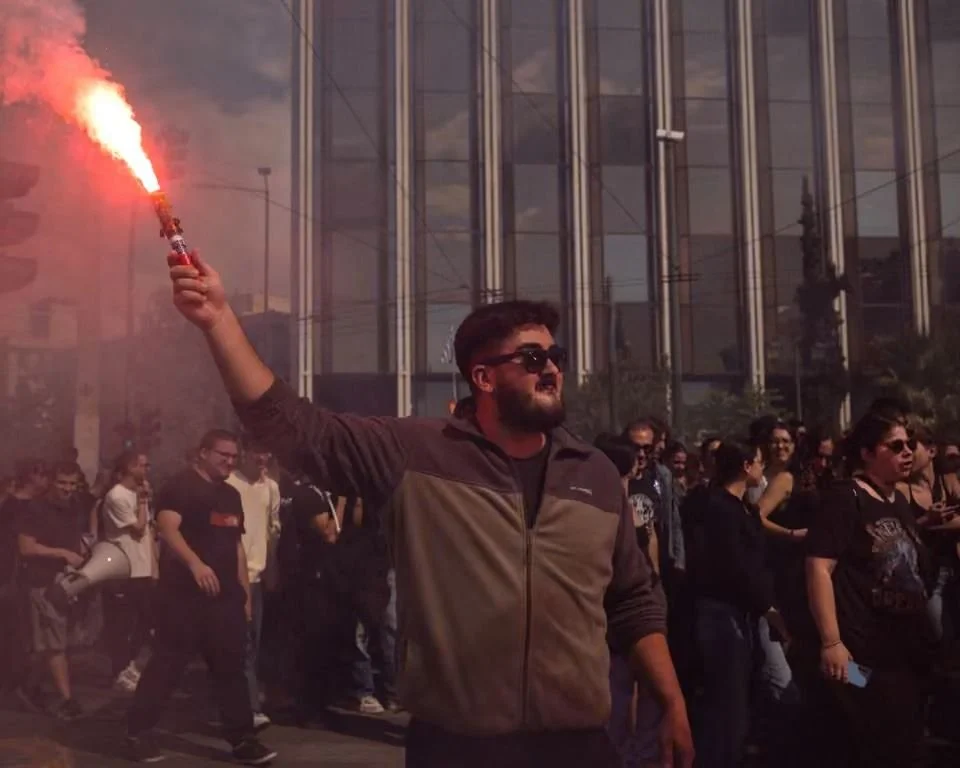
Workers protest new labor laws in Greece, 2025
Across the country, cadre in the Multinational Communist Party encounter workers who echo the same refrain, “No one wants to organize! I can’t get my coworkers to take action! I don’t have the time or energy to do this!”
None of this is true. What saps your energy is that you are mired in defeat, lost in the woods with no signs to show the way. It’s time to free yourself.
We in the working class, when pressed by the exploitation of capitalism, are motivated to withhold our labor – to engage in direct class struggle by going on strike. The labor movement, even in the imperial core, was built by workers completely shutting down the circulation of profit, cutting off the oxygenated flow of wealth to the undead capitalist beast. Just last year, both France and Greece had massive general strikes.
But the pressures of capitalism have a transformative effect on the character of the labor movement itself. This is seen more acutely in the US, the innermost core, than in other Western countries. Through lobbying, patronage, threats, and infiltration, capital has seized control of union leadership. These leaders in turn have steered us away from direct struggle and towards the capitalist legal system, developing a hyper-legalist mindset that has worked its way down through the rank-and-file.
This practice of compromise and capitulation leads to repeated failure, followed by apathy and stagnation. But if the compromisers in the labor movement can be decisively defeated, direct struggle will intensify, higher wages and better conditions will be won, and the fighting spirit of our class will ignite.
Part 1: The Tendency Towards Legalism
“The legal committee is also essential, but the left wing must always be careful to hold the lawyers in check. They have a rather fatal habit, once they are engaged, of trying to run the whole strike as well as their legal department. If they succeed in this they soon strip it of all militancy and reduce it to a state of impotent legalism. They are also notoriously poor fighters at the conference table.” – ‘Strike Strategy’, William Z. Foster, 1927. A practical guide for communists organizing the workers struggle by the former leader of the Communist Party USA.
In recent years, there has been a surge of worker militancy, producing several high profile organizing campaigns. In spite of the outpouring of worker energy, the tendency towards compromise, labor peace, and litigation – and the pitfalls therein – is still evident. Two campaigns; the “Fight for $15” and the struggle of Starbucks Workers United, are emblematic of this tendency and should be analyzed in depth.
The Fight for $15
The campaign began with organizers of service industry workers looking to address the abysmal wages in the fast food industry:
“SEIU locals in New York City began organizing fast food workers in 2012, and grabbed national attention with a one-day strike by 200 workers demanding “$15 [an hour] and a union.” This was more than double the federal and state minimum wage, $7.25.
The bold demand and strike inspired a national Fight for 15, backed by SEIU and allied unions. It spread to 58 cities in 2013 and more than 500 cities by 2015, and gradually broadened its focus to include home care, airport, and retail workers.”
The strategy:
“The objective wasn’t to organize store by store—there were 200,000 fast food outlets in the U.S., mostly owned by franchisees—but to raise the federal minimum wage to $15, improve working conditions, and build public and regulatory pressure on the major fast food employers that could eventually be leveraged to demand union recognition and collective bargaining.”
“However… the campaign did not result in new members or a self-sustaining organization of fast food workers. While the slogan was “$15 and a union,” the union part often seemed secondary. The campaign focused almost entirely on directly pressuring employers and winning better legislation.”
This paragraph shows the danger Foster warned about. The legalist strategy advocated by the compromisers is not meant to be an addition to the organization of the working class, rather a substitution for the workers’ struggle. In direct class struggle, labor confronts capital on the field of production. Legalism disempowers the working class by removing direct struggle and replacing it with a campaign for legislative intervention. Legalism redirects the energy of workers away from the capitalists and towards a third party – capitalist politicians – who then are meant to intercede in the struggle on the workers behalf. The capitalist ruling class could not design a better system for managing their contradictions with labor if they built it from scratch. One might grant the compromisers the benefit of the doubt if this scheme ever actually worked.
Let’s also note that $15 in 2012, when the campaign began, would be the equivalent of $22.10 today. As of 2026, 18 states have a minimum wage higher than $15, but not a single one of those is at or above $22. The highest minimum wage in the country, $17.95, is only equivalent to $12.66 in 2012 dollars. Not a single state has surpassed a 2012 $15 minimum wage when adjusted for inflation.
It was obvious from the outset that inflation would destroy the campaign even if lawmakers acquiesced. But when you remove Marxist political education from the labor movement, you are left with slogans developed by marketing teams rather than political analysts. In the end, the legalist strategy did little more than blow a hole in the union’s treasury:
“SEIU spent between $70 million and $180 million on the Fight for 15.”
Workers must remember this when compromisers tell them that organizing campaigns and strikes are too expensive. When funds – from dues paid by members – are demanded for direct struggle, there is much hemming and hawing. But the doors of the treasury are thrown open without a moment’s hesitation for the attorney’s hourly fee or the local official’s election canvass. The compromising labor leadership’s first priority is always to contain struggle to the site most favorable to the capitalist ruling class.
Starbucks and the Boardroom Struggle
In 2021, workers in Buffalo, NY formed Starbucks Workers United. Even the name of the local betrays the inclination to compromise, with the union’s adoption of the company brand drawing a needless division between Starbucks baristas and workers in the rest of the service industry. Since their formation, SBWU has been fighting for a labor contract with the corporation for five years.
The first Starbucks union election was in December of 2021. Their first strike – a symbolic one-day strike – did not come until nearly a year later, in November of 2022. In February 2024, workers believed they were nearing victory when negotiations finally began – but their hopes were dashed in December of 2024 when Starbucks reneged on all previous agreements and negotiations collapsed.
Throughout this period, baristas’ demands for liveable wages and reasonable staffing have mostly been ignored. And the NLRB has served as no panacea:
“Starbucks is the biggest violator of labor law in modern history as Administrative Law Judges (ALJ) at the National Labor Relations Board (NLRB) have found that Starbucks has committed more than 400 labor law violations...”
Note that these are only the violations the union has found and had the resources to file.
“...In a stunning rebuke to Starbucks, an ALJ recently recommended a broad cease and desist order against Starbucks’ unlawful union busting, stating: “[Starbucks] has engaged in a scorched earth campaign and pattern of misconduct in response to union organizing at its stores across the United States. […] I take notice that despite several Board orders and dozens of ALJ decisions, Respondent’s behavior continues unabated.”
The multibillion dollar corporation scoffs at the NLRB’s speeding tickets. But the response from union leadership has mainly been to double down, waging a legal war of attrition:
“To date, Workers United has filed more than 1,000 ULPs [unfair labor practice], including more than 125 since January 2025. More than 700 unresolved charges remain, including… specific ULPs around retaliatory firings and discipline.”
Retaliatory firings are the very risk which union leaders use to justify their overreliance on NLRB-sanctioned strikes. They scare workers with warnings about what capitalists call an “illegal strike”. But an illegal strike means that the employer can fire strikers without facing fines. By contrast, a “legal strike” is one where the employer is required by law to rehire striking workers or distribute backpay once the conflict is over. How effective has the law been at enforcing labor regulations thus far?
Nevertheless, the union has been pushing relentlessly towards the conference table to engage in “framework bargaining”. As if the NLRB process were not long enough, said framework bargaining is merely a precursor to contract negotiations. The framework, were it agreed upon, would only set the boundaries within which contract negotiations would take place:
“National framework bargaining began in April 2024. Over the subsequent nine months, baristas and Starbucks executives met for hundreds of hours and notched 33 tentative agreements that will tangibly improve the workplace. In September 2024, union baristas first presented a set of economic proposals for negotiation to increase wages and benefits.
In December 2024, Starbucks said “no” to all of the baristas’ proposals and, in exchange, put forth an unserious economic package that did not raise wages in the first year of the contract, nor did it address the core issues of hours and staffing. Talks broke down.
Starbucks backtracked on the previously agreed-upon path forward. This prompted Workers United to file a national unfair labor (ULP) practice charge in December 2024 alleging Starbucks had failed to bargain in good faith and was undermining the representative status of the union. This ULP was amended and expanded in April 2025.
Workers United has filed over 100 new ULPs over the last year.”
After discussions between the union and the company broke down, the union turned to the NLRB. The union’s response to Starbucks’ refusal to talk over a conference table was to seek a larger table. How many workers – how many of them good organizers – quit or were fired just during this nine month period?
Finally, on November 13th, 2025, SBWU began its “Red Cup Rebellion” strike. The action started with 1,000 workers at 65 of the over 600 union stores. The strike lasted for 131 days with approximately 3,000 workers participating at the peak of the campaign – a large number, but less than half of the total membership at that time. Where was everyone else? Cadre from the Multinational Communist Party, who have attended several pickets in solidarity, report that in most of these strikes the shop remains open. This matches a similar practice seen in the Amazon strikes organized by the Teamsters, “[a]t the DBK4 delivery station in Queens, New York, 200 drivers struck… Eight [Amazon contractors] operate out of the Queens location, with a total workforce of 700 to 800 drivers.”
The picket serves not to shut down production, but to encourage potential customers to boycott the establishment. This alone might serve to answer why the campaign has become a quagmire. A work stoppage must also be a production stoppage if the capitalist is to feel economic pain.
The Price of Legalism
There is a material cost to the strategy of litigation, delay, and compromise. Most workers who have organized experience the onset of apathy as the stagnation of protracted campaigns begin to set in. Feelings of hopelessness result in declining participation in the campaign.
This is compounded by the current structure of the economy. The Service Industry makes up around 74% of US economic output. Healthcare, Hospitality, Retail Trade, Transportation and Warehousing, Wholesale Trade, Private Education, and IT workers make up nearly 48% of the workforce.
Unions are desperately needed in lower wage service work. But there is a 60% yearly turnover rate in retail, a 90% turnover rate in sitdown restaurants, and in counter-service restaurants yearly turnover exceeds 110%. By the time a union campaign has passed the one-year mark, every worker in the shop may be gone. Maintaining the same core of worker-organizers for a multiyear campaign without improvements in wages or conditions is nearly impossible. Given these turnover rates, combined with the protracted nature of modern union campaigns, how many workers will see a campaign all the way from NLRB vote to contract signing?
Part II: The Struggle Within the Labor Movement
In order to convince workers to submit to such a torturous, failed strategy, the compromisers have completely replaced Marxist political education and subjected us to an unending barrage of legalist indoctrination.
The character of this indoctrination can be understood by its phraseology; ‘fair pay’, ‘fair contract’, ‘unfair labor practice’, ‘good faith negotiation’, etc. But the use of the word fairness implies that the current socioeconomic system is just. It implies that the system is capable of producing a desirable outcome so long as both sides adhere to a common set of rules.
But there lurks danger within these seemingly benign appeals. This phraseology obscures the actual contradiction of the capitalist mode of production. Labor and capital cannot be reconciled because workers need higher wages and better working conditions to survive and capitalists need lower wages and more efficient productive technology to grow profits and capital. Any set of rules which in their totality would benefit one side must, inevitably, harm the other.
Under a political system controlled by the capitalist ruling class, the established rules and laws will only be designed to favor capitalism. If workers adhere to such a code in ‘good faith’, they only undermine their own position because the rules are set against them. This is the exact opposite of fairness.
From Litigation Towards Political Education and Workers Democracy
In order to end the rigged game, we must bring Marxism and worker democracy back to our unions. Marxist analysis serves two important functions. First, it brushes away the debris of legalist indoctrination. Second, by outlining a clear plan of action, it unites great numbers of workers around a single objective.
Unity of action is amplified by worker democracy. We must accelerate the formation of committees and caucuses within our unions to take up pressing issues and spread them to the broader membership.
Union leadership election campaigns are extremely expensive to undertake and notoriously difficult for challengers to win. But there are no effective constraints on the ability of union members to meet, educate each other, sharpen demands, and propagate those demands to the broader membership.
A union composed of a politicized, organized membership is more effective than any reform slate. The latter – once in office – is still plagued by pressure from capitalists, subversion from defeated incumbents, and the need to win over the large, apathetic swathes of members who did not champion reform or even participate in the election.
On the other hand, when confronted by a politicized and organized membership, even the most compromising union leaders must choose between acquiescing to the masses or seeing their regime collapse.
From Arbitration Towards Direct Struggle
The growth of committees and the politicization of members will lead to a shift away from a reliance on NLRB arbitration and towards direct class struggle – towards strikes. In the same vein, workers will shift away from appealing to bourgeois legislatures and towards mass strikes and general strikes.
As priorities shift, so will class consciousness, further accelerating the change. Workers will understand that the NLRB and bourgeois legislation are not paths to liberation, but merely tools to codify victories that have already been won through direct class struggle. The codification of victory under the bourgeois legal system will still be a necessary part of the class struggle until the dictatorship of capital is defeated. But this is because it allows for the preservation of momentum and energy, and serves as an indication to the broader masses who have not yet been brought into the class struggle that the working class is capable of both fighting and winning. It should not serve as an end unto itself.
Part III: Class Struggle
As the grasp of legalism on the working class begins to slip, a militant working class will be unleashed. Based on our current power we can calculate what the effects will be. Let’s continue to use the Starbucks struggle as an example.
As of 2026, Starbucks has 11,222 stores in the US. Net revenue for its stores per quarter stands at $4.208 billion. That makes the average revenue per store – per quarter – $374,925 or $4,166 per store per day.
If six hundred Starbucks stores were completely shut down, the company would lose $2.5 million in revenue in a single day. After a week, the company would lose $17.5 million dollars. In a month, $70 million in revenue would be lost. After three months, losses would total $210 million – nearly 5% of quarterly revenue in just 90 days. Based on Starbucks’ fiscal 2026 report, a loss of five percent would almost erase the year-on-year revenue growth between March of 2026 and March of 2025.
Looking at wider industry figures, a recent study calculated how many work days in total were lost due to strikes in 2024. It then calculated how much revenue was lost from the cumulative missing labor time (all the days that all workers were on strike combined). In the hospitality and food service sector, the cumulative striking days for all workers totalled 236,200 days and cost the industry $105,084,123 in revenue.
These are losses that are spread throughout individual industries, not concentrated on a single target. To return to Starbucks Workers United; if all of the union’s 12,000 members went on strike, they could reach the above mentioned industry-wide figure in just 19 days. The economic impact on a single company would be enormous.
With greater impact comes greater concessions in a shorter time. Intensity, militancy, and a complete halt of production is what is needed to combat the obstacles of worker apathy, stagnation, and campaign collapse from high turnover. Faster campaigns and greater wins will drive workers towards the struggle. William Z. Foster:
“In all situations where the fighting qualities of human beings are called into play the question of morale assumes great importance. Military leaders understand this thoroughly. They know that the strength of an army is not to be measured simply by its numbers, or even by its favorable strategic situation. The question of the degree of fighting spirit among the troops, their morale, is a factor of decisive weight. Hence, during wars, strategists devote the closest attention to this matter of morale…
Strike strategy, no less than military strategy, must give close concern to the question of morale. This is because strikes, like military campaigns though in a lesser degree, are tests of the courage and endurance of their participants. The tenacity, durability, discipline, and general effectiveness of a strike largely depend upon the morale of the workers involved…
The question of morale is, therefore, a fundamental one in strike strategy. Our problem is how to create and maintain it… The whole strike strategy must be so calculated as to infuse the strikers with courage and an indomitable fighting spirit. Everything that tends to make the strike effective tends also to raise the spirits of the strikers. A good morale is not a thing by itself; it is the product of a generally successful strike direction.”
The Subjective Struggle of the Working Class
We have been suffocated by the professional compromisers of the labor movement. This has allowed a great deal of wealth to be stolen from us by the capitalist ruling class. But we can snatch it back. We must increase the militancy of our strike actions. We must be firm and direct that our objective is to completely halt production until our demands are met. We must discard the meaningless distinction between “legal strikes” and “illegal strikes”.
Any strike which benefits us and harms the capitalists is illegal. To work or not to work is a choice – our choice. Will we be so beholden to legalism that we allow the capitalists to legislate away our right to food and water? What the capitalists and compromisers truly mean when they try to scare us with these phrases is that some strikes are (weakly) protected by the law, while others are not. That is all. But in either case, the only protections we can truly rely on are solidarity and victory.
If we fight, we will win. The compromisers will either join the working class or be discarded along with their incorrect ideas. But this objective change in the character of the labor movement must be preceded by a subjective change. That is, we as individual members of the working class must wake up each morning and choose struggle. We must choose militancy. We must choose victory.